Assets older than your company. Documentation that has to satisfy a regulator decades later.
Your VPs of Engineering and Asset Integrity carry the responsibility for documenting assets that have been in service for fifty, seventy, sometimes a 100 years. API 1163 governs in-line inspection systems. ISO 55000 governs asset-management systems. Both require traceable, immutable documentation across the asset's life — the original construction records, every inspection, every repair, every modification, every condition assessment.
Talk to an Asset Integrity solutions engineer · Read the energy microsite · Read the audit-ledger pillar
"My MRO documentation has to satisfy API 1163 and ISO 55000 for assets that have been in service longer than my company."
"My MRO documentation has to satisfy API 1163 and ISO 55000 for assets that have been in service longer than my company." — VP Engineering / Asset Integrity (— Severity 4 × Frequency 4 × Urgency 5)
The asset-integrity reality in oil & gas is that documentation is the difference between operating and shutting down. An inspection finding that cannot be tied to a documented baseline becomes a regulator finding. A repair record that cannot be retrieved becomes an insurance-claim dispute. A condition assessment trapped in a retired vendor's proprietary archive becomes a recurring re-acquisition cost.
3 failure modes recur:
- Documentation lives in 20 systems built across 40 years. Original construction records on paper. Early inspections in microfiche. ILI runs in vendor proprietary formats. Recent inspections in EAM modules. Repair records in maintenance work-order systems. The asset-integrity team spends 40-60% of its time just locating evidence.
- The chain of custody is broken at every system handoff. When an inspection vendor delivers ILI tool runs, the bytes arrive but the provenance does not transfer cryptographically. The auditor's "prove this is the original 2008 ILI run" question has no answer.
- Long retention without confidence. Quality records under IATF 16949 / AS9100 require 30-year retention; pipeline integrity under PHMSA requires lifetime retention. Without a tamper-evident audit ledger, "we kept the records" cannot be proven cryptographically.
What TeamSync gives the VP Engineering / Asset Integrity.
1. The Intelligent Maintenance Repository as the asset's documentation timeline.
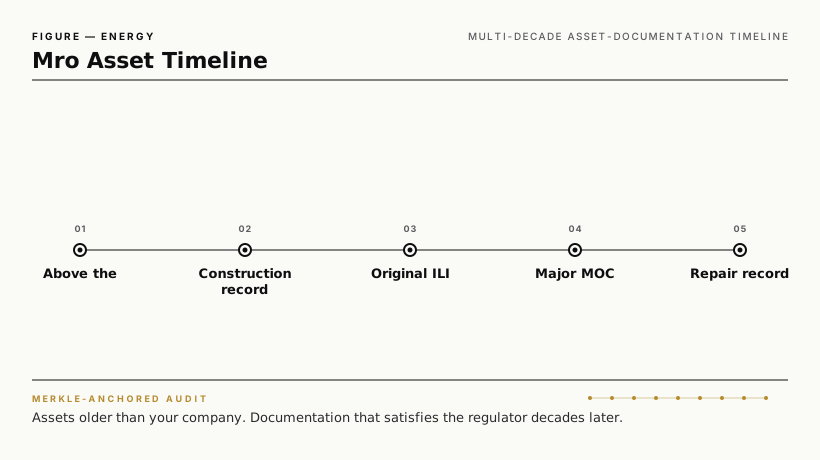
Every asset has a documentation timeline in TeamSync — original construction records, every inspection, every repair, every MOC, every condition assessment, every regulatory report. The timeline is queryable: "show me everything that touched valve V-1234 between 2018 and 2025." The answer is one query against one repository.
2. Specialised viewers for asset documents.
Petroleum well logs (DLIS / LAS), pipeline ILI runs (PIDX), CAD drawings (DXF / DWG / STEP), high-fidelity P&IDs — TeamSync's specialised viewers render them natively without exporting to a vendor desktop client. Field engineers consult them on mobile.
3. The audit ledger anchors every asset event.
Each inspection, each ILI run, each repair, each MOC closure adds an event to the Merkle audit ledger. The chain is cryptographically linked across decades. Tampering with any historical event invalidates the chain. The PHMSA inspector — and the BSEE inspector, and the OGUK auditor, and the insurance-underwriter assessor — can verify the chain via one API call.
4. The agentic AI workflow handles MOC orchestration.
Every change to an in-service asset triggers a TeamSync Agentic AI Workflow. Reviewer-approver-verifier-closer chain enforced. Linked PSI documents updated atomically. The MOC package on regulator demand is a query, not an assembly project.
5. DocuTalk grounds the asset-integrity conversation.
Questions like "what was the inspection finding on V-1234 in 2018, and what repair followed?" — DocuTalk returns the answer with citations to the inspection report and the repair work order. The asset-integrity team's tribal-knowledge queries (the senior engineer who retired and took the answers with them) become institutional queries.
Compliance frameworks satisfied.
| Framework | Coverage |
|---|---|
| API 1163 (In-line inspection systems qualification) | Inspection-record retention + chain-of-custody |
| API RP 1173 (Pipeline safety management) | Documented safety-management evidence |
| ISO 55000 / 55001 (Asset management) | Asset-information requirements + lifecycle records |
| PHMSA 49 CFR 192/195 (gas + liquid pipelines) | Operator qualification + integrity-management records |
| BSEE 30 CFR 250 (US OCS) | Asset-integrity + SEMS records |
| OSHA Process Safety Management 29 CFR 1910.119(j) | Mechanical-integrity records |
| ISO 14001 (environmental management) | Document-control evidence |
| SOC 2 Type II, ISO/IEC 27001 | Cross-vertical |
How TeamSync compares for the VP Engineering use case.
| Capability | TeamSync | SLB Techlog | Halliburton Landmark | OpenText for Energy | Maximo / SAP PM |
|---|---|---|---|---|---|
| Specialised asset-document viewers (DLIS, LAS, PIDX, P&ID) | ✅ | ✅ Subsurface | ✅ Subsurface | OpenText viewers | Limited |
| Cross-asset documentation timeline (multi-decade) | ✅ Merkle-anchored | – | – | OpenText overlay | Per-EAM |
| Cryptographic chain-of-custody on inspection records | ✅ | – | – | – | – |
| MOC orchestration with bounded autonomy | ✅ Agentic | – | – | OpenText Process Suite | Maximo workflow |
| AI grounded across asset documentation | ✅ DocuTalk | Techlog AI (subsurface) | Landmark AI | Aviator | Limited |
| Per-cluster transparent pricing | ✅ | Per-product | Per-product | Bundled | Per-module |
Important: TeamSync coexists with SLB Techlog and Halliburton Landmark — they own subsurface engineering. TeamSync owns the asset-integrity, MRO, MOC, and HSE document estate alongside.
CTAs.
| If you are… | Do this |
|---|---|
| VP Engineering / Asset Integrity | Talk to a solutions engineer |
| Pipeline Integrity Manager under PHMSA | Read the audit-ledger pillar |
| Reliability Engineer building a multi-decade asset history | Read the energy microsite |
| Internal auditor designing an API 1163 control test | Read the eDiscovery brief |
| Buyer running an asset-integrity-document RFP | Read the vertical-specific regulated-workflow use case |
Frequently asked questions.
Can TeamSync ingest legacy ILI runs from vendor proprietary formats?
Yes. Most major ILI vendors (Rosen, Baker Hughes, T.D. Williamson, ROSEN, NDT Global) deliver runs in PIDX or vendor-specific formats; TeamSync's ingest pipeline normalises them to a queryable format while preserving the original bytes for forensic re-analysis. Audit-ledger anchored at ingest.
What about microfiche and paper records from the 1960s–1980s?
The metadata-extraction pipeline supports OCR on scanned legacy records. Customers run a one-time digitisation project (often vendor-led) and bring the digitised records into TeamSync; the audit ledger records the digitisation event with a forensic-evidence pack.
How long is asset documentation retained?
Tenant-configurable. Pipeline operators typically configure lifetime retention on integrity-management records; petroleum operators configure 30-year retention on inspection records; manufacturing operators configure IATF 16949 / AS9100 multi-decade retention. The audit ledger remains cryptographically verifiable across the retention period.
Does TeamSync replace Maximo or SAP PM?
No. Maximo / SAP PM are the EAM (enterprise asset management) systems that track work orders, spares, and maintenance schedules. TeamSync is the document-of-record layer alongside, holding the inspection reports, MOC packages, P&IDs, and PSI documents that the EAM references. The integration is a connector pattern.
How does this interact with our subsurface workflow on SLB or Landmark?
Coexistence. Subsurface stays in Techlog or DecisionSpace 365. Asset-integrity, MRO, MOC, HSE document estate moves to TeamSync. The subsurface tool's outputs (well logs, formation evaluations) can be referenced from the TeamSync asset-document timeline.
Related capabilities
- Intelligent Repository — the asset-document timeline foundation
- Agentic AI Workflow — MOC orchestration
- DocuTalk — institutional-memory queries
- eDiscovery — regulator-response collection
- Tamper-evident audit ledger — cryptographic chain across decades