Decisions you can change without redeploying the workflow.
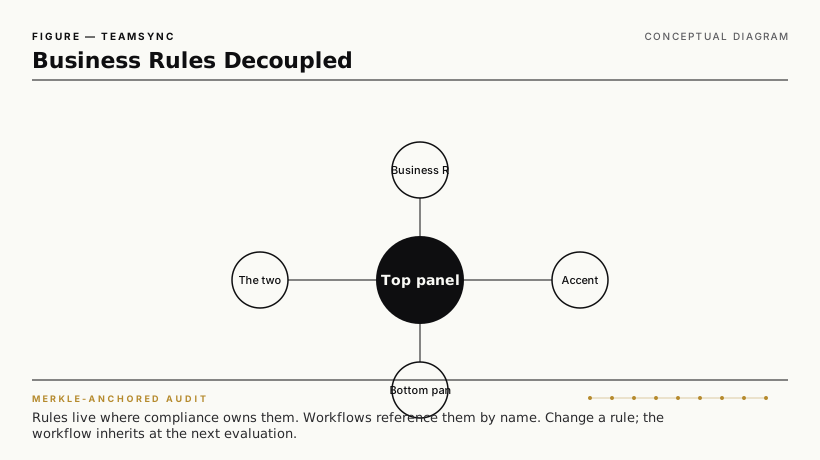
Business rules in TeamSync live separately from the workflow that uses them. The compliance team or the line-of-business owner edits a rule; the workflow inherits the change at the next decision point. AI agents reference the same rules as the static workflow paths — bounded autonomy by design. Every rule evaluation is audit-anchored.
Talk to a rules-engine solutions engineer · Read the agentic AI workflow pillar
What's in the engine.
| Component | Purpose |
|---|---|
| Rule editor | Decision-table, decision-tree, and DMN-standard editing for compliance / business teams |
| Rule library | Versioned rules with approval workflow; audit-anchored versions |
| Rule reference from workflows | Workflow nodes reference rules by name; rule changes propagate at next evaluation |
| Rule reference from AI agents | Agentic AI Workflow agents bound by the same rules |
| Conflict detection | Static analysis of rule overlap, contradiction, dead-code |
| Simulation | Test a rule change against historical decisions before publishing |
| Audit ledger | Rule version, evaluation, decision, exception — all anchored |
Why rules-engine-as-a-separate-thing matters.
When a regulator updates the threshold (DORA's evolving thresholds for "critical function," AML/KYC threshold updates, EU AI Act risk-tier classifications), the change is to the rule, not to the workflow that uses it. Customers without a separate rules engine schedule a release for every rule change — months of cycle time. With a rules engine, the compliance team makes the change in minutes.
Frequently asked questions.
Does TeamSync support DMN (Decision Model and Notation)?
Yes. DMN 1.5 import + export. Existing DMN models from Camunda, FICO Blaze Advisor, IBM ODM can be imported.
Who owns the rules — IT or the business?
The business. The rule editor is designed for non-engineering users (compliance officers, line-of-business managers, records officers). IT owns the workflow that uses the rules.
How do I test a rule change before publishing?
The simulation runs the candidate rule against the historical decision stream and shows the divergence — which past decisions would have changed and how. The compliance team reviews the divergence; the rule is published or revised.
Related capabilities
- Business Process Automation — the workflow consumer
- Agentic AI Workflow — AI agents bounded by rules
- Tamper-evident audit ledger — every evaluation anchored